AR/VR in Architecture: 10 Innovative Applications Shaping the Future
Introduction
Table of Contents
The architectural industry has always embraced innovation to improve design, communication, and construction processes. Among the most transformative technologies reshaping the field today are Augmented Reality (AR) and Virtual Reality (VR). These immersive technologies are revolutionizing the way architects conceptualize, present, and execute projects by creating interactive experiences that bridge the gap between imagination and reality.
From enhancing client presentations to improving construction accuracy, AR and VR are becoming essential tools in modern architectural practice.
Understanding AR/VR in Architecture
Although often discussed together, AR and VR serve different purposes in architectural design.
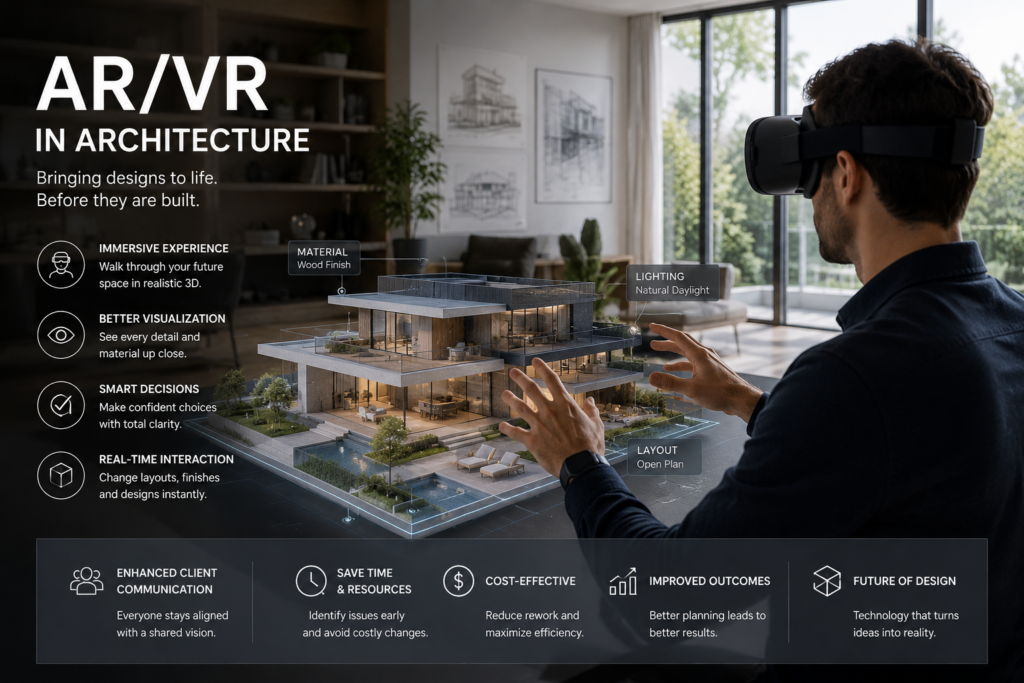
Virtual Reality (VR) creates a fully immersive digital environment that allows users to experience and interact with a building before it is constructed. By wearing VR headsets, clients and stakeholders can virtually walk through spaces and realistically understand design concepts.
Augmented Reality (AR) overlays digital information onto the real-world environment. Using smartphones, tablets, or AR-enabled devices, users can visualize architectural elements within existing spaces and construction sites.
Together, these technologies provide powerful tools for design visualization, collaboration, and decision-making.
Enhancing Design Visualization
One of the most significant advantages of AR/VR in architecture is the ability to transform traditional design presentations into fully immersive experiences. For decades, architects relied on 2D drawings, blueprints, and static 3D renderings to communicate their ideas. While these methods remain valuable, they often require clients to interpret technical information that can be difficult to understand without architectural expertise.
By using AR/VR in architecture, designers can place clients inside a virtual representation of their future home, office, or commercial building before construction even begins. Instead of imagining how a space might look, clients can walk through rooms, observe ceiling heights, evaluate furniture placement, and experience the flow of the entire building in real time.
Key benefits include:
- Realistic understanding of room dimensions
- Better visualization of layouts and circulation
- Accurate perception of materials and finishes
- Enhanced understanding of natural and artificial lighting
- Increased confidence in design decisions
This immersive approach significantly reduces uncertainty and allows architects to present their ideas with remarkable clarity. As a result, AR/VR in architecture help create stronger client relationships while improving the overall design process.
Improving Client Communication
Effective communication has always been one of the greatest challenges in architecture. Technical drawings, elevations, and floor plans can be difficult for clients to interpret, often leading to misunderstandings that result in expensive revisions during construction.
With AR/VR in architecture, communication becomes far more intuitive and engaging. Rather than explaining a design through drawings alone, architects can guide clients through a fully interactive virtual environment where every room, corridor, and outdoor space can be explored at full scale.
Clients are able to:
- Walk through the proposed building before construction
- Experience room proportions and circulation paths
- Compare multiple design alternatives instantly
- Evaluate views from different windows
- Understand the relationship between indoor and outdoor spaces
This immersive collaboration encourages meaningful feedback early in the project, reducing costly design changes later. By improving transparency and client involvement, AR/VR in architecture create smoother project workflows and significantly increase client satisfaction.
Accelerating Design Development
Another major advantage of AR/VR in architecture is the ability to identify design challenges long before construction begins. Traditional design reviews often reveal problems only after detailed drawings are completed, making revisions more time-consuming and expensive.
Immersive technologies allow architects to experience their designs from the perspective of future occupants, making it easier to evaluate functionality, accessibility, aesthetics, and overall user experience.
Benefits include:
- Faster design reviews
- Early identification of spatial conflicts
- Reduced design revisions
- Improved workflow efficiency
- Better coordination between architectural disciplines
By detecting issues during the conceptual stage, AR/VR in architecture help reduce project risks while saving valuable time and construction costs. The result is a more efficient design process that benefits architects, engineers, contractors, and clients alike.
Supporting Collaborative Design
Modern construction projects involve collaboration among architects, structural engineers, interior designers, MEP consultants, contractors, and clients. Coordinating all these stakeholders can be challenging when each discipline relies on separate drawings and documentation.
AR/VR in architecture provide a shared digital environment where every participant can review the project together in real time. Instead of discussing abstract drawings, teams interact with a realistic virtual building, making coordination faster and far more effective.
This collaborative environment enables participants to:
- Review complex building models together
- Compare multiple design options
- Identify construction conflicts before work begins
- Coordinate structural and MEP systems
- Make faster, data-driven decisions
By improving collaboration, AR/VR in architecture minimizes communication gaps, reduces project delays, and creates a more integrated design process from concept through construction.
Enhancing Construction Accuracy
The benefits of AR and VR in architecture extend well beyond the design studio. On construction sites, augmented reality is increasingly being used to overlay digital building models onto physical environments, allowing contractors to compare completed work with the original design in real time.
Construction teams can use AR to:
- Verify layouts before installation
- Position structural components accurately
- Guide mechanical and electrical installations
- Perform quality-control inspections
- Monitor construction progress
This technology reduces costly errors, minimizes material waste, and improves overall construction quality. As digital workflows become more common, AR and VR in architecture are playing an increasingly important role in delivering projects with greater precision and efficiency.
Conclusion
Augmented Reality and Virtual Reality are transforming the architectural industry by enhancing visualization, improving communication, streamlining collaboration, and increasing construction accuracy. These technologies allow architects and clients to experience projects before they are built, reducing uncertainty and enabling more informed decisions.
As AR/VR become increasingly integrated into architectural workflows, they will continue to shape the future of design and construction, helping create smarter, more efficient, and more innovative built environments. Firms that embrace these technologies today will be better equipped to meet the demands of tomorrow’s architectural landscape.